Market Report: The Gold Melt Squeeze Is Reshaping the Vintage Watch Market
by Matthew Bain (a Dealer With 30 Years in the Business)
In over 30 years in the vintage watch world, I’ve seen just about every cycle — the Daytona booms, GMT crazes, Submariner mania, auction spikes, and everything in between. For nearly two decades, stainless-steel sport watches were the heartbeat of the market.

But in the last three to five years, collectors have shifted sharply toward gold — heavy, luxurious, full-weight watches with presence. And at the exact same moment, gold has exploded to $4,000 an ounce, creating one of the strangest and most disruptive market environments I’ve seen in my entire career.

A New Reality: Melt Value Is Setting the Market Floor
For the first time in the modern vintage era, some collectible gold watches are worth more melted down than they are as watches.
And it’s not rare or obscure pieces — it’s well-known, mainstream gold watches that historically traded comfortably above melt. We're experiencing a very real market paradox — gold timepieces are en vogue and sought after, yet the "collector" value is having trouble keeping up with the material value. The split has never exited before in this way.
What I Saw at the Antique Show — A First in My 30 Years
I recently had a booth at a major antique show, and what I witnessed truly shocked me, even after three decades in this business.
Dealers weren’t just showing gold watches.
They were weighing them before negotiating.
Digital scales everywhere.
Bracelets removed and weighed separately.
Case backs weighed.
Everything converted to grams and material melt value in real time.

I heard multiple dealers decline offers because:
“Your offer is below melt — I can melt this for more.”
And they were talking about:
gold Piaget bracelet watches
gold Patek Philippe integrated pieces
Not junk.
Not scrap.
Real watches. Some even including the premium demanding accessories such as original boxes and papers - still going to melt.
When dealers openly prefer the crucible over the retail market, you know something unprecedented is happening.
Why This Is Happening
Gold’s surge erased the traditional premium.
A watch containing $12,000–$25,000 worth of gold creates a hard floor.
If market demand is soft, the melt number wins.
Demand for many gold dress models hasn’t fully recovered.
While gold sport models are hot, some gold dress pieces (Patek, Piaget, certain AP references) are still slower movers.
Dealer margins are thinner.
In uncertain markets, melt value becomes a safe, guaranteed exit. "A bird in the hand..." if you will.
Not all gold watches have equal collector demand.
A gold Daytona is a trophy.
A 1980s gold integrated bracelet dress watch?
That’s melt territory right now.
What Collectors and Dealers Need to Know
Scales are now as important as loupes.
Every serious dealer weighs gold pieces before negotiating.
Certain references may become rare.
Every melted gold Piaget, Patek, or AP reduces the surviving population — which could create future scarcity.
Condition premiums still exist — for the right watches.
A sharp gold Day-Date still outperforms melt value.
But a tired integrated Patek bracelet watch?
That’s melt math now.
This is a unique opportunity.
Collectors can buy some gold watches only 10–20% above melt — numbers that were unthinkable 10 years ago.
A Market Moment We’ve Never Experienced Before
Gold has always added value to a watch — but now, the metal itself is sometimes the entire value.
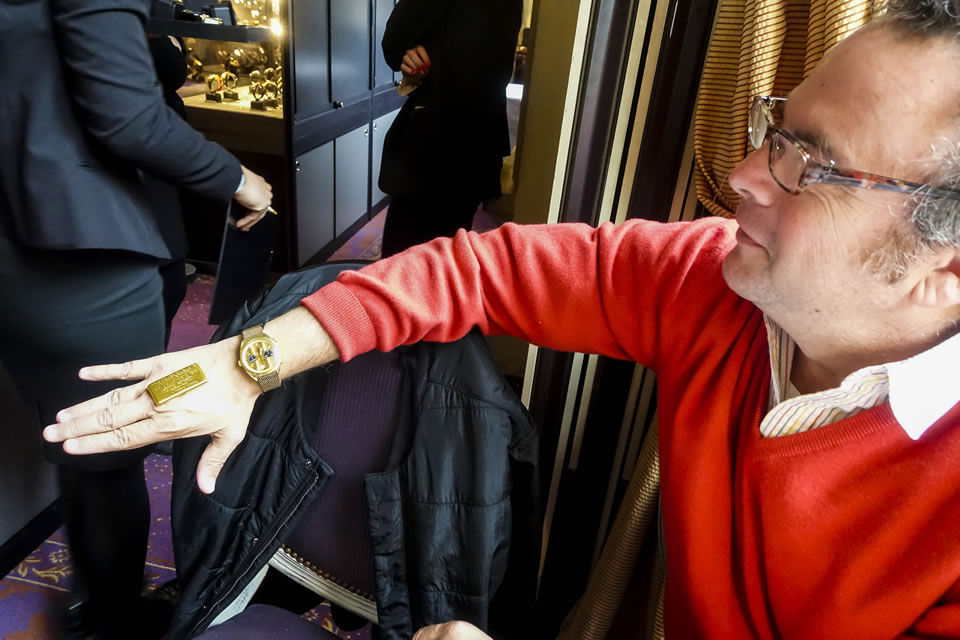
This is a once-in-a-generation market distortion — and it’s reshaping the vintage watch industry in real time.
Anyone who is actually melting vintage gold watches (as opposed to just using it as a negotiating tactic) should be named and shamed. These objects are irreplacable, and if you are destroying them for a little extra money you are a barbarian.
good analysis