"Is It Polished?"
By Matthew Bain
Many times the very first question I get asked is:
“Has the watch been polished?”
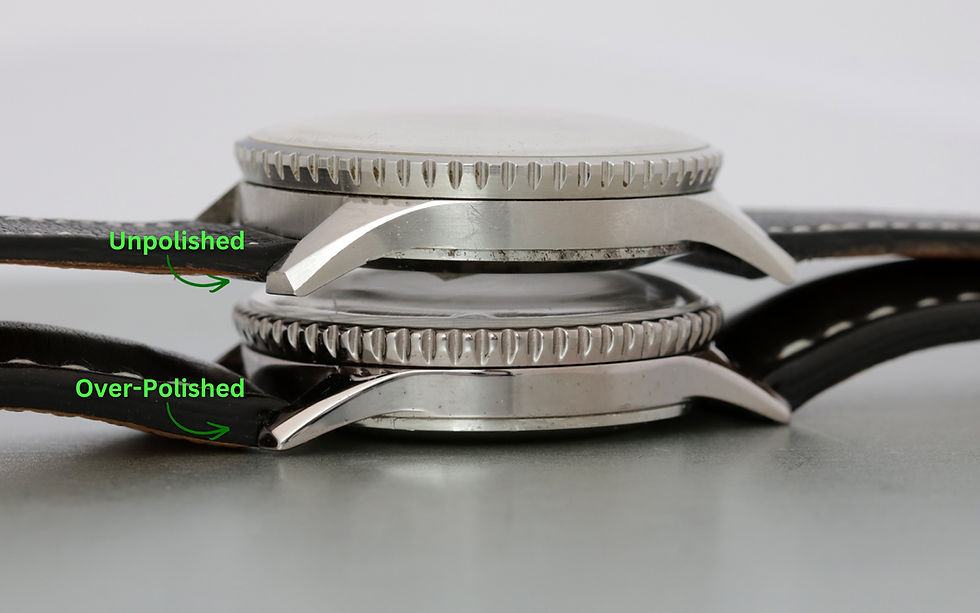
It’s a fair question, but often the question itself is misunderstood and used completely out of context.
Some collectors, and blossoming enthusiasts tend to speak about polishing as if any polishing automatically destroys a watch. That's simply not true. The reality is far more nuanced. Although it is sometimes difficult to move past our very human desire to see things clear-cut as black or white.
For example, A 50 or 60 year-old watch that's received a light, sympathetic polishing over decades of wear, while still maintaining its original proportions, bevels, lines, and overall integrity, should not automatically suffer a major impact in value.
Now, if a watch has been heavily over-polished- where the lugs are rounded, the case proportions are distorted, the edges are soft, and the original character has been lost, that is an entirely different story. Over-polishing or poorly done jobs can absolutely hurt both collectability and value.
But the subjective component of these decisions really depends on your collecting goals.
Are you trying to buy the absolute purest, untouched, museum-level example in existence? Or are you looking for a beautiful vintage watch that still presents honestly and retains strong overall integrity?
Those are two very different collecting mindsets.
Another part of the discussion that people rarely talk about is balance. Would you rather own a watch that is completely untouched but so heavily worn that it has lost much of its beauty and visual appeal? Or would you rather own a watch that has been excessively polished simply because it looks shiny and costs less?
The strongest vintage watches often fall somewhere between those two extremes, with watches that have aged naturally while still preserving the original case shape, proportions, bevels, and overall character.
That said, my own personal preferences have always leaned with the purists toward natural, unpolished watches, whether heavily worn or preserved in exceptional condition. I would take an honest, untouched case over an overly polished watch any day of the week. There's something special about a watch that has aged naturally and still carries the original lines and intentions of the manufacturer. Even wear can tell a story.
Some people can't stand scratches or signs of wear. Personally, I appreciate them.
To me, honest wear can add character and authenticity to a vintage watch.
I sometimes ask people: “When someone's 65 years old, do they have wrinkles?”
Of course they do.
Vintage watches are no different. If a watch has lived an honest life over 50 or 60 years, a few scratches, marks, and signs of aging should not automatically be viewed as flaws. In many cases, they are part of the watch’s story.
The problem comes when people try to erase that story entirely through excessive polishing and restoration. That is often where a watch begins to lose its soul and original character.

The reality is that most vintage watches that are 40, 50, or 60 years old have lived a life. Many were serviced by the manufacturer at some point. During those periods, light polishing was extremely common and often considered standard practice, not sacrilege. In fact this conversation itself regarding the appreciation and value effects of polishing watches is relatively recent in the history of these things.
A watch can still be incredibly attractive, collectible, and historically important even if it has seen a careful polish somewhere along its journey.
In many ways, condition should be judged holistically.
How is the case shape overall? Are the lugs still full? Are the bevels still visible? Has the watch retained its original lines and proportions? How is the dial? Has the watch been excessively restored? Does the watch still have presence and honesty?
These questions matter far more than reducing condition down to a simplistic “polished” or “unpolished” label.
Ironically, some collectors become so obsessed with the word “unpolished” that they stop evaluating the actual watch sitting in front of them. I have seen watches described as “unpolished” that looked terrible, and I have seen lightly polished watches that were absolutely beautiful and retained outstanding integrity.
At the highest level of collecting, nuance matters. The goal should not simply be chasing buzzwords. The goal should be understanding the watch.

To simplify things, I often look at vintage watches in a few different categories:
Understanding the difference between these categories is far more important than simply asking: “Is it polished?”
New old stock: never polished, virtually untouched. These are the dream examples and often command the highest premiums.
Lightly worn but never polished with a very sharp case: This is often the sweet spot for many serious collectors.
Heavily worn but never polished: These watches may show significant wear and scratches, but they still retain originality and honesty.
Worn and lightly polished but still retaining the original lines, bevels, proportions, and character of the case: This is where many beautiful vintage watches live.
Over-polished watches: These have lost their original form and collector quality, but sometimes appeal to buyers simply looking for a shiny aesthetic at a lower price point.
Cases that were “cut” or heavily reworked to imitate an unpolished appearance: In many ways, this can be worse than honest polishing because the watch is no longer authentic to its original form.
Great information, thank you